| Our group recently visited the library at the Nova Scotia College of Art and Design to see their collection of artist's books. The NSCAD library has a large collection of artist's books by many local artists dating back to the 1970s when the concept of artist's books was just emerging. The collection includes a wide range of items showing how broadly the category can be interpreted which, of course, led to some great discussion around the long-debated question: What is an artist's book anyway? We had an opportunity to see a variety of chap books, book art objects, art books, exhibition catalogues, moveable books, as well as fine press books and other related items. Of particular interest to us were the two CBBAG collections, the "Millenium in a Box" (2000) and the "Book Arts Mosaic" (2005). The "Millennium in a Box" contains the work of 35 artists from across Canada. Each artist's piece was created as an edition of 50 and then one of each is included in the boxes that are held at libraries across the country. In similar fashion, the "Book Arts Mosaic" box includes twenty-six works by thirty-three artists across Canada. The pieces included in these collections are predominantly book art objects but there are also examples of chap books, collections of prints, handbound journals, etc., and the various items showcase many book art techniques and materials. A range of bookbinding structures can be found here, including this example of a tunnel book by Ann Stinner and an unusal lectern structure made by Karen and Geoffrey Hewett. There is an example of a miniature binding by Robert Wu and a set of prints by the Ottawa Press Gang. Also, an accordion with handmade paper and calligraphy by Cathryn Miller and a pamphlet with hand lettering by Triha Klus. These are obviously just a few of the dozens of items included. If you have an opportunity to examine these collections you will also find examples of scrolls, Japanese bindings, a cuneiform tablet, handmade paper with special watermarks, resin casting, letterpress prints, woodblock prints, shibori, paper marbling, paste papers, lino cut printing, calligraphy, xylography, wax resist, as well as a bit of traditional bookbinding and fine binding. Both collections are featured on the CBBAG website with some additional information about the items as well as lists of the libraries where the collections can be found. |
        |
| The NSCAD library is open to the public. They will also loan circulating items to anyone with a Halifax Public Library card or anyone who is a student at one of the other local universities. Thank you to Rebecca Young, director of library services, for providing us access to these collections! | |

Showing posts with label NSCAD. Show all posts
Showing posts with label NSCAD. Show all posts
Sunday, July 26, 2026
NSCAD Library Artist's Book Collection
Thursday, January 18, 2024
Printed Matter Exhibit: Gallery Copy Only
 Currently displayed at the Anna Leonowens Gallery in Halifax, is an exhibit of work by NSCAD students who have been studying the world of printed matter in all its forms. It is an amazing collection of work featuring many different book and paper forms and structures, traditional and experimental, interpreted through a connection to printed content.
Shown here (left) is a miniature handbound book by Charles Salmon featuring 13 weeks of typed class notes reproduced at 10% actual size, with final page size of just 1.25" wide and 1.75" tall.
There are 18 artists included in the exhibit with several pieces by each artist so there is a lot to see. The variety of work is indicative of a wonderfully creative and thoughtful group. The range of content in these pieces is so vast it would take weeks to absorb it.
 It was thrilling to see how the artists used different structures, forms, scale, and materials to create and enhance the content of their work.
Entering the gallery, I was greeted by a video display of flickering images on one wall. There was hanging text in the corner and connected text in the windows. There was also a small table with a newspaper cone and discarded milk glasses which, I assume, made a splash at the opening reception. Another wall was hung with carved wooden panels and various printed objects.
The first to grab attention, though, was the wall covered with this colourful collection of birthday cards (right). The birthday card display was created by Annette MacLellan. Every day of the year was represented and each card had a personalized note inside. I found my birthday card, and the sentiment wished for me that my favorite thing might be on sale, how nice!
There were a number of well-executed pieces by Charles Salmon in this exhibit including the miniature book shown above. Charles' work demonstrates an impressive attention to detail and refinement including pieces that showcase his skills in bookbinding, paper folding techniques, and box making. His choice of content and materials are wonderfully complemented by the structures he uses for his artist's books.
A small sample of his work is shown here (below), including a striking folded paper structure featuring literary texts and a thoughtful deconstructed notebook with instructions for the user/reader.

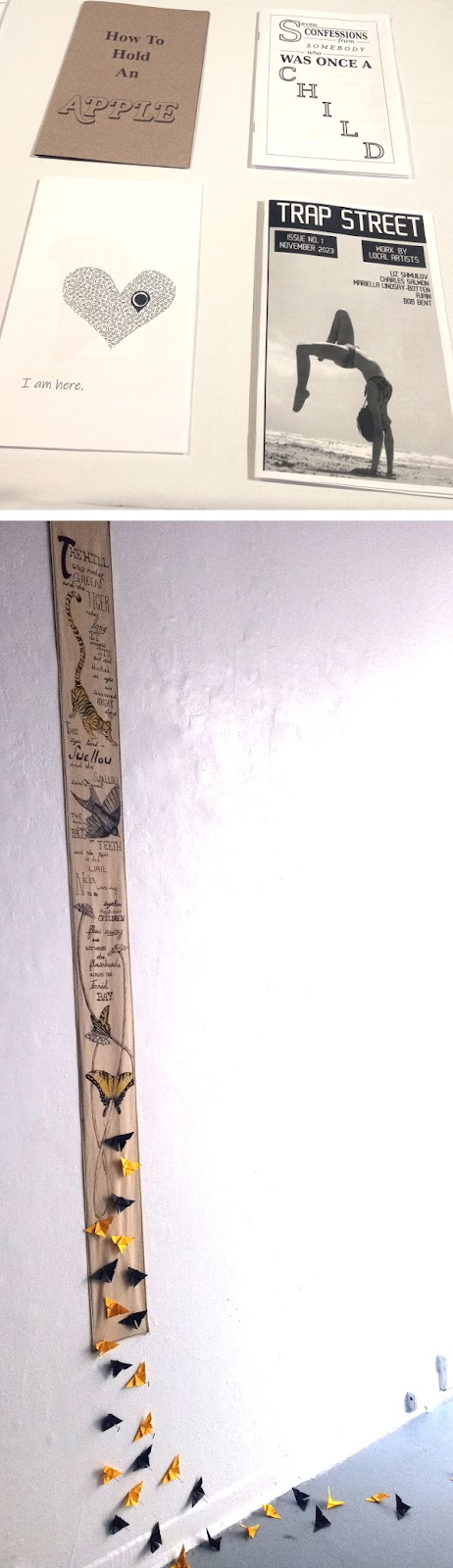 There is an extensive collection of zines made by members of this group exhibit, just a few of them are shown here. Rhynn Winstead's zines, "Seven Confessions from Somebody Who was Once a Child" and "Trap Street," are particularly interesting examples that demonstrate the broad range and uses for the zine format since the the first is more personal content and the second is a newsletter-style zine intended for public distribution.
Rhynn Winstead has several other pieces in the exhibit too, including this beautiful wall-mounted fabric piece (right). Like a hanging scroll, it is illustrated with images and text and it has a flock of origami butterflies fluttering up from the floor.
There is so much to see in this exhibit and this overview only scratches the surface. There are some books made with very traditional techniques and there are also others made of cloth and bingo cards and upcycled cardboard. There are a number of pieces incorporating plastic and unusual materials like chicken wire and trousers and pillows and pencil shavings.
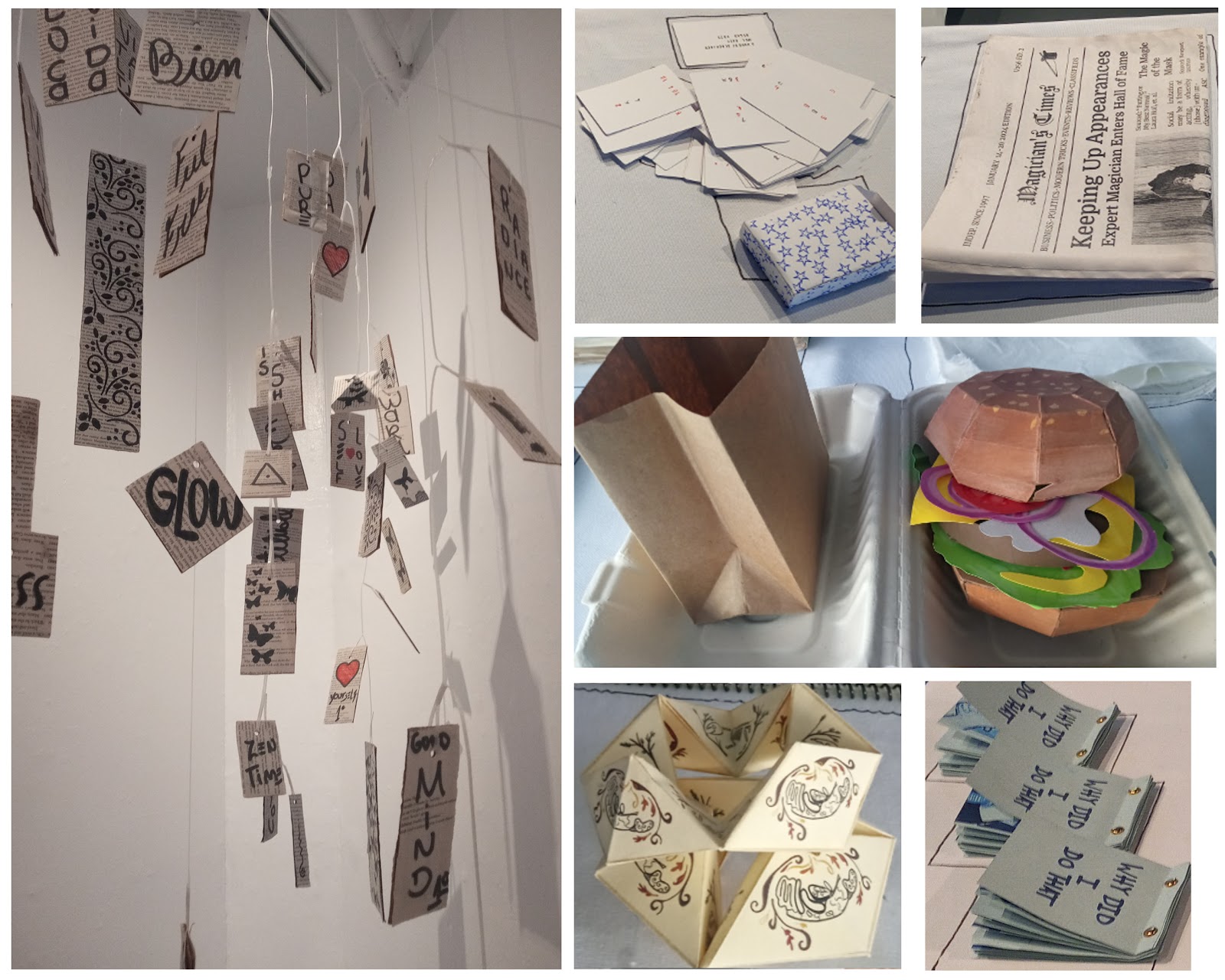
The following are just a few more examples of various book and paper forms that were used, ranging from traditional to unconventional.
Shown clockwise (below): hanging text by Joana Bernardini; Playing cards by Melissa Naef; Newspaper by Cameron Walker; Paper burger by Vesa Muji; Set of three booklets by Chelsea MacDonald; Flexagons by Baily Smith.
Artists included in this exhibit:

Submitted by Rhonda Miller
Tuesday, October 10, 2023
Mind Your P's and Q's
A Dawson Print Shop & Bindery Exhibition
Mind Your P's and Q's, a Dawson Print Shop and Bindery Exhibition, was recently held (Sept. 26 - Oct. 7, 2023) at the Port Loggia and Treaty Space Gallery. These bright, open, fully accessible galleries are located on the ground floor at NSCAD's Port Campus on the Halifax waterfront.
The letter "p" and the letter "q" are often confused when setting type. This exhibition takes its name from the expression, "mind your p's and q's," which was heard in print shops for generations, including the Dawson Print Shop.
As curator/organizer Odyssean Press offers, "This exhibition is a celebration of book arts and letterpress printing at NSCAD University, as well as the contributions of the Dawson Print Shop & Bindery within NSCAD and the wider arts community in Kjipuktuk (Halifax). It includes both "traditional and experimental book arts practices" including bookbinding, artist's books, letterpress printing, and tool making.
Mind Your P's and Q's features the work of 16 artists who are connected to the Dawson Print Shop, through material, techniques or training. Exhibitors include NSCAD instructors Joe Landry and Katherine Taylor and Centre for Craft instructor Rhonda Miller. NSCAD students and Dawson Print shop alumni (and their associates) include: Morgan Cruickshank, Emily Doucette, Nat:Shaw, Julie Rosvall, Ellen Timbre & Tina Arsenault, Charles Salmon, Shadow, Deirdre Sokolowska, Sush, Em Tremblay and Robin Wolfe. As well as the work of curator/organizer, Odyssean Press.
Examples of traditional bookbinding techniques with inspiring workmanship were many and included works by Robin Wolfe, Odyssean Press, and Katherine Victoria Taylor's book which was specially created for the Dawson Print Shop anniversary. The cover printed by Katherine is composed of over a thousand pieces of decorative metal type which creates optical blending to form a single letter "D."
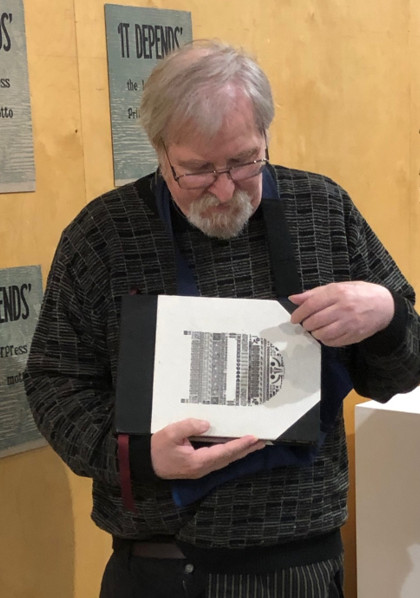 Joe Landry with the guestbook made by Katherine Victoria Taylor |
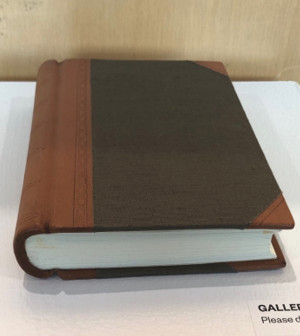
 Half leather bindings by Robin Wolfe | |
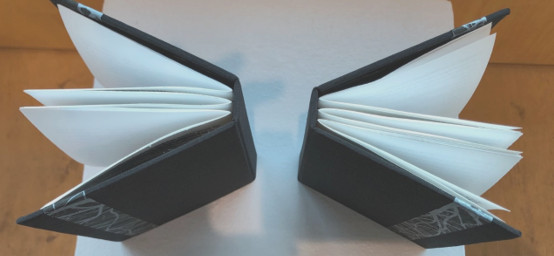 Handbound books by Odyssean Press |
||
 |
 | |
| Springback journal by Rhonda Miller |
Wi'katikn Wa'qn hand-forged book knife by Shadow |
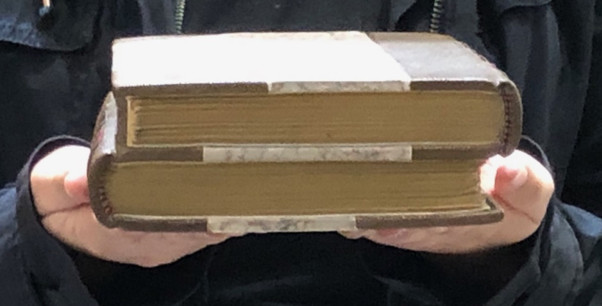
Dos-A-Dos binding by Joe Landry
One book's cover was made from apple twigs which are woven together using paper-covered wire. This book was made by the artist as part of a series of artist's books featuring related materials. One visitor commented, "probably the most inventive in terms of materials."

Cover as Metaphor, artist's book by Charles Salmon
The cover of another book - Interspace by Emily Doucette, "resembles an envelope." When opened, its accordion pages cascade "into a variety of different scanned envelopes." Ribbons are used to tie this case bound accordion binding shut.
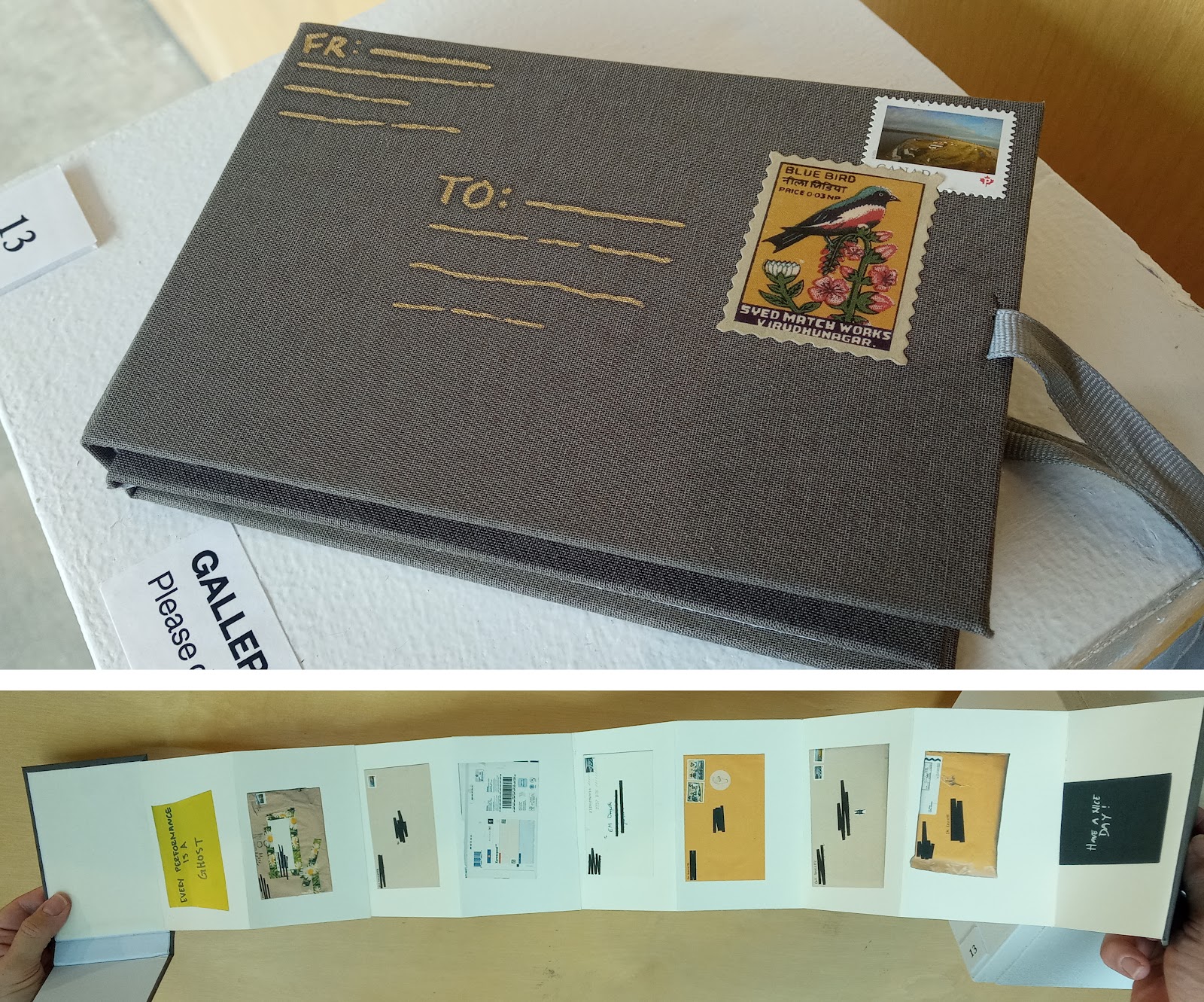
Interspace, artist's book by Emily Doucette
Popular with visitors was Odyssean Press' A Family History as seen through Tattoo Traditions. Bound within this artist's book were two miniature accordion books that spoke to the different tattoo traditions of the creator's ancestors. One book was dedicated to their mother's ancestors and the other to their father's ancestors, and both incorporated watercolour and ink drawings.
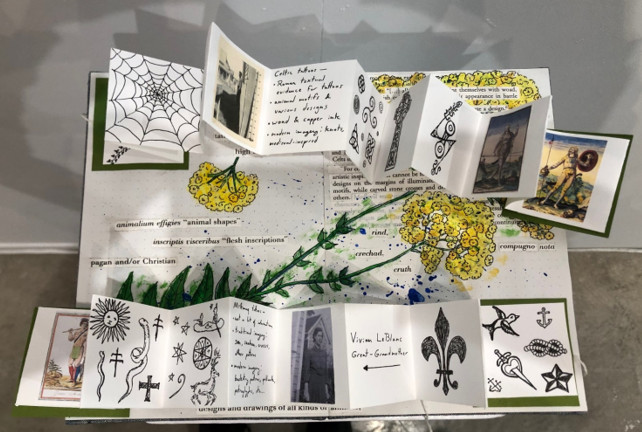
A Family History as seen through Tattoo Traditions, artist's book by Odyssean Press
Other miniature books included a book bound in a box by Morgan Cruickshank that was inspired by a larger version seen at the Dawson Print Shop, which in turn was inspired by the structure of the Kennicott Bible. A miniature accordion book with striking precision, created by Sush, was among many miniatures on display that they created at the Dawson using scraps.
 Benjamin by Morgan Cruickshank |
 scrap yard, a collection of miniature books by Sush |
| While some works were protected under Lucite, the majority weren't and allowed for gentle hand-held examination by visitors. Deirdre Sokolowska's creation, William & I features a series of colour photos of the creator holding a dead bird which they found. Deirdre offers, "accompanying this visual narrative is a short story recounting a childhood misunderstanding related to Resurrection Sunday." Within Sokolowska's hardcover pamphlet, kozuke paper is used to hold each photo in place. The concept of finding a dead bird as a basis for a book is reminiscent of Margaret Wise Brown's children's book The Dead Bird. The charcoal, graphite and ink drawings in Em Tremblay's journal is "an exploration of some of the darker parts of their mental health journey." The brown kraft-like pages are bound with a traditional Japanese stab binding. |
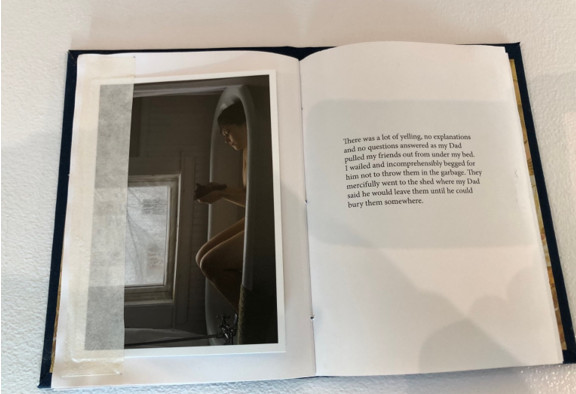 William & I by Deirdre Sokolowska  Handbound journal by Em Tremblay |
The skill demonstrated in Joe Landry's full leather design binding was impressive. The cover featured abstract shapes of black, white and red leather onlays and inside featured ultra smooth black leather "doublure" - "an ornamental lining on the inside of the book." This book was Joe's final project for his design class at London College of Printing.

Design binding with custom box by Joe Landry
| Superb and stunning craftmanship was in evidence with Rhonda Miller's Experiment with Embroidery, which uses stitching patterns inspired by traditional blackwork embroidery, supported by more traditional chain and link stitch binding techniques. The Dawson Print Shop was formerly part of Dalhousie University where many Nova Scotians studied and practiced book arts including bookbinders Joe Landry, Rhonda Miller, Tracy Leal, Robin Muller and librarian Patricia Chalmers, to name a few. The Dawson became part of NSCAD in 2000. |
 Experiment with Embroidery by Rhonda Miller |
The bright and airy Port Loggia gallery (which runs the length of the Port Campus) allowed for up-close examination of Julie Rosvall's works with collaborators Ellen Timbre and Tina Arsenault. This collaboration included textile relief prints, letterpress prints and bookbinding, featuring their artist's book - Contexture - knit print book collaboration. Previously shown at the Craig Gallery, Dartmouth, Julie's practice was inspired by the work of artist and printmaker Esther Goodwin. Read more about Julie's work here. |
 Julie Rosvall discussing Contexture |
Other printed works on display included Circle Book (Embodiment of Cyclical Growth) by Odyssean Press, consisting of bookbinding, ink drawing and relief print.
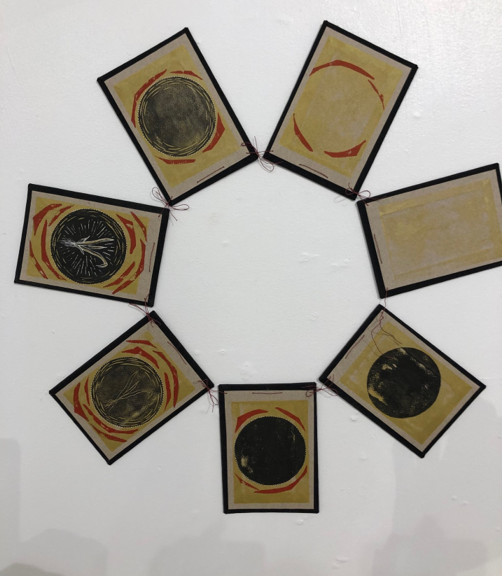
Circle Book (Embodiment of Cyclical Growth) by Odyssean Press
Playful yet moving, was the grid of twelve letterpress prints by Nat:Shaw. The white, dark brown and medium brown papers were imprinted with the phrase "Not broken just spicy." Four different spices are referenced: Paprika, Cayenne, Cinnamon and Cardamom. During their artist talk, Nat:Shaw related that they are coming up to the second anniversary of a head concussion injury. Nat:Shaw offers, "The significance of the phrase ("Not broken just spicy") being a mantra of sorts for coming to peace with being neurodivergent or "Neuro-spicy."

Nat:Shaw discussing their work, Various Neuro-spices
Seeing how artists Em Tremblay, Deirdre Sokolowska, Odyssean Press and Nat:Shaw incorporate their intimate personal experiences into their practice is both powerful and inspiring.
Equally inspiring was seeing all the thoughtfully and beautifully-made books brought together for display in Mind Your P's and Q's at NSCAD's Port Loggia and Treaty Space Gallery.
Submitted by Charles Salmon
Saturday, July 15, 2023
Pages Turning, group exhibit
Pages Turning, at NSCAD's Anna Leonowens Gallery, is a gutsy group exhibition that forces the
viewer to question what our concept of a book is, and what a book is supposed to look like.
Curated by graduating student Neil Kehler, a photography major with an obvious interest in the book form. This exhibition captures the zeitgeist of how new millennial art and design students conceptualize books.
These super-sized, in-your-face, works of art are 'one of a kind' editions. Unlike most "hands off" exhibitions, here viewers are encouraged "please handle the work... do so with tenderness and care."
Metal Frame as Book
 Crisp, clean paper sheets are attached at each end to two vertical metal screw posts that stand
about 2.5 feet tall. The square metal rod base is about a foot wide. Each sheet of paper is
separated from the other by evenly-spaced hexagon metal nuts. The 36 alternating sheets
cover both sides of the posts, gently overlapping and progressively covering each other, like
tree branches. When lifted, each page reveals an imprinted single line of text that stands
alone, yet connects to the preceding page and the page that follows. Symmetrical, graceful and
precise is the overall effect of this pushing-the-boundary book.
Crisp, clean paper sheets are attached at each end to two vertical metal screw posts that stand
about 2.5 feet tall. The square metal rod base is about a foot wide. Each sheet of paper is
separated from the other by evenly-spaced hexagon metal nuts. The 36 alternating sheets
cover both sides of the posts, gently overlapping and progressively covering each other, like
tree branches. When lifted, each page reveals an imprinted single line of text that stands
alone, yet connects to the preceding page and the page that follows. Symmetrical, graceful and
precise is the overall effect of this pushing-the-boundary book.
Canvas as Book
 A singular rectangular gessoed canvas sheet with frayed sides and edges hangs like a medieval
banner on the gallery wall.
A singular rectangular gessoed canvas sheet with frayed sides and edges hangs like a medieval
banner on the gallery wall.
This quiet, simple and subtle book commands our attention by its imposing size (19.5" wide by 36" long) which is contrasted by its faintly painted and difficult to read black text, making the viewer stop, linger and investigate.
Collage as Book
 Instead of being elevated on a pedestal, this collage book's enormous open size (65" wide by
52" tall) demands that it be displayed on the gallery floor. Five double-page spreads of bold
collage pages (using paint, paper and photocopies) comprise this multi-layered, rough texture
book.
Instead of being elevated on a pedestal, this collage book's enormous open size (65" wide by
52" tall) demands that it be displayed on the gallery floor. Five double-page spreads of bold
collage pages (using paint, paper and photocopies) comprise this multi-layered, rough texture
book.
"The book as sovereign," forces the reader to acknowledge this reverse power play by either bending over or kneeling down to engage with its huge 32.5" by 52" pages. The physical effort is worth the visceral and visual reward.
Quilt as Book
 Traditional quilts play with pattern and colour. This quilt plays with letters and words. The
medium is the metaphor - fragments of fabric comprise fragments of text.
This imposing (48" wide by 64.5" long) 12-panel quilt features white fabric block letters
appliquéd to a bold red fabric background. The resulting text message wraps around the quilt
border and circles inward. Sometimes the words appear in black fabric, calling out for our
attention, like bold face text. Curiously, sometimes the letters are not appliquéd, but pinned to
the fabric.
Traditional quilts play with pattern and colour. This quilt plays with letters and words. The
medium is the metaphor - fragments of fabric comprise fragments of text.
This imposing (48" wide by 64.5" long) 12-panel quilt features white fabric block letters
appliquéd to a bold red fabric background. The resulting text message wraps around the quilt
border and circles inward. Sometimes the words appear in black fabric, calling out for our
attention, like bold face text. Curiously, sometimes the letters are not appliquéd, but pinned to
the fabric.
Each quilt block (14" wide by 15.5" long) is held together, not by tightly stitched thread, but at its corners with safety pins. As a result, when hung, the quilt does not lay flat, but sags with huge gaps that look like pouches. Upon closer examination, this optical illusion disappears. Is the subtext that the weight of the message is too great for the fabric to bear?
Almost all book structures require the reader to hold the book close in order to read and comprehend the text. However, in this case the opposite holds true. The reader needs to distance themselves from the book (i.e., quilt) in order to read and comprehend the text. Traditional bookbinding studies primarily focus on structure. The Pages Turning exhibition books integrate content with structure in unexpected and innovative ways.
Kehler's curatorial statement offers: "As time rolls on books may take on new purposes and forms of which we cannot conceive, and it is conceivable also that our relationship to them will change."
The Anna Leonowens Gallery is located on the cobblestoned Granville Street pedestrian mall of the Fountain Campus of NSCAD University in Halifax, Nova Scotia. Pages Turning is on display from July 11 to 15, 2023.
These super-sized, in-your-face, works of art are 'one of a kind' editions. Unlike most "hands off" exhibitions, here viewers are encouraged "please handle the work... do so with tenderness and care."
Crisp, clean paper sheets are attached at each end to two vertical metal screw posts that stand
about 2.5 feet tall. The square metal rod base is about a foot wide. Each sheet of paper is
separated from the other by evenly-spaced hexagon metal nuts. The 36 alternating sheets
cover both sides of the posts, gently overlapping and progressively covering each other, like
tree branches. When lifted, each page reveals an imprinted single line of text that stands
alone, yet connects to the preceding page and the page that follows. Symmetrical, graceful and
precise is the overall effect of this pushing-the-boundary book.A singular rectangular gessoed canvas sheet with frayed sides and edges hangs like a medieval
banner on the gallery wall.This quiet, simple and subtle book commands our attention by its imposing size (19.5" wide by 36" long) which is contrasted by its faintly painted and difficult to read black text, making the viewer stop, linger and investigate.
Instead of being elevated on a pedestal, this collage book's enormous open size (65" wide by
52" tall) demands that it be displayed on the gallery floor. Five double-page spreads of bold
collage pages (using paint, paper and photocopies) comprise this multi-layered, rough texture
book. "The book as sovereign," forces the reader to acknowledge this reverse power play by either bending over or kneeling down to engage with its huge 32.5" by 52" pages. The physical effort is worth the visceral and visual reward.
Traditional quilts play with pattern and colour. This quilt plays with letters and words. The
medium is the metaphor - fragments of fabric comprise fragments of text.
This imposing (48" wide by 64.5" long) 12-panel quilt features white fabric block letters
appliquéd to a bold red fabric background. The resulting text message wraps around the quilt
border and circles inward. Sometimes the words appear in black fabric, calling out for our
attention, like bold face text. Curiously, sometimes the letters are not appliquéd, but pinned to
the fabric.Each quilt block (14" wide by 15.5" long) is held together, not by tightly stitched thread, but at its corners with safety pins. As a result, when hung, the quilt does not lay flat, but sags with huge gaps that look like pouches. Upon closer examination, this optical illusion disappears. Is the subtext that the weight of the message is too great for the fabric to bear?
Almost all book structures require the reader to hold the book close in order to read and comprehend the text. However, in this case the opposite holds true. The reader needs to distance themselves from the book (i.e., quilt) in order to read and comprehend the text. Traditional bookbinding studies primarily focus on structure. The Pages Turning exhibition books integrate content with structure in unexpected and innovative ways.
Kehler's curatorial statement offers: "As time rolls on books may take on new purposes and forms of which we cannot conceive, and it is conceivable also that our relationship to them will change."
The Anna Leonowens Gallery is located on the cobblestoned Granville Street pedestrian mall of the Fountain Campus of NSCAD University in Halifax, Nova Scotia. Pages Turning is on display from July 11 to 15, 2023.
Review by Charles Salmon
Thursday, May 18, 2023
Boxes of all kinds
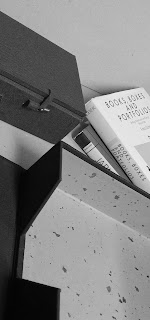 At our group meeting yesterday, Joe Landry spoke to us about various box structures and presented a wide variety of samples from his collection.
Master bookbinder, Joe Landry, has been binding books since he was a little boy, seated at the bench in his uncle's bindery in Halifax. Joe received his formal training in England at the London College of Printing. Upon graduation, Joe studied conservation of rare books and manuscripts at West Dean College, University of Sussex, where he apprenticed with noted book and paper conservator Chris Clarkson. At Montefiascone, Italy, Joe taught conservation to students from all over the world. Since 1999, Joe has taught hundreds of students at NSCAD University in Halifax, Nova Scotia. He has produced books for film and television, and has made regular appearances on the acclaimed History Network series, The Curse of Oak Island, to offer advice and expertise on book-related matters. Joe has had some very prestigious clients, including King Charles III, and examples of Joe's work are held in a number of collections internationally.
Joe showed us over twenty different box structures and book enclosures. These examples included many that he'd made as well as numerous historic examples that he has collected over the years. Joe shared his experiences working with and constructing various styles of protective enclosures and how they are used in library and conservation settings. Thank you Joe, for your knowledge, your time, and your stories!
Submitted by Rhonda Miller
Wednesday, October 26, 2022
Nocturne "Legacy": printing, collage, and origami
Nocturne, Halifax's October contemporary arts festival, is now in its 15th year. This year's theme of "Legacy," featured installations of particular interest to book and paper arts enthusiasts.
Outside the Dawson Print Shop on the Granville Mall, Katherine Taylor, a NSCAD book arts and letterpress instructor, was running a "hands on" demonstration of a table top printing press. This family-friendly exhibit let people experience making a colour pressure print. Based on Ms. Taylor's Ukrainian legacy, she had the word "Family" carved using Cyrillic letters, into a lino block. It was then printed on a base print of an intricate flower pattern, reminiscent of paper filigree. The chipboard base print pressure plate was cut using a Cricut machine, which can reproduce and cut most paper material and almost any pattern that is uploaded to a computer. The design possibilities for cards, posters, end plates and text blocks is virtually limitless.
The Legacy theme continued over at Inkwell letterpress studio on South Park Street, with another interactive print/paper activity. Billed as "Mind your Ps and Qs," prints of common English language phrases originating from the print industry, were created on a 1921 cast iron printing press that uses carbon negative ink made from algae. Like the Dawson Print shop, each participant went home with a print.
On Lower Water Street, the Halifax Collage Collective created a large, paper-based mural collage. Participants were asked to comb through paper-based materials and ephemera like old magazines, journals, drawings, printed material, etc., and select items that they felt contributed to their personal legacy. Using scissors, glue and drawing materials, a paper-based collage was created that encouraged participants to reflect on their personal legacy.
At the Chase Gallery (located in the NS Archives, on the Dalhousie University campus), a group show based on identity called "I Am What I Am," featured works using materials ranging from acrylic, paint and fabric to metal, found objects and paper mâché. Among those featured, was Miya Turnbull, a Japanese Canadian artist living in Nova Scotia whose art practice is informed by Japanese paper work. Among Ms. Turnbull's works was a series of Origami Self Portraits (of crane, frog, heart, box and butterfly) created from colour photographic prints incorporating the artist's eyes and lips. This original approach in utilizing deconstructed facial features in origami was both mesmerizing and unsettling.
While Nocturne is over, "I Am What I Am" continues until Oct. 29th, 2022.

Review by Charles Salmon
Outside the Dawson Print Shop on the Granville Mall, Katherine Taylor, a NSCAD book arts and letterpress instructor, was running a "hands on" demonstration of a table top printing press. This family-friendly exhibit let people experience making a colour pressure print. Based on Ms. Taylor's Ukrainian legacy, she had the word "Family" carved using Cyrillic letters, into a lino block. It was then printed on a base print of an intricate flower pattern, reminiscent of paper filigree. The chipboard base print pressure plate was cut using a Cricut machine, which can reproduce and cut most paper material and almost any pattern that is uploaded to a computer. The design possibilities for cards, posters, end plates and text blocks is virtually limitless.
The Legacy theme continued over at Inkwell letterpress studio on South Park Street, with another interactive print/paper activity. Billed as "Mind your Ps and Qs," prints of common English language phrases originating from the print industry, were created on a 1921 cast iron printing press that uses carbon negative ink made from algae. Like the Dawson Print shop, each participant went home with a print.
On Lower Water Street, the Halifax Collage Collective created a large, paper-based mural collage. Participants were asked to comb through paper-based materials and ephemera like old magazines, journals, drawings, printed material, etc., and select items that they felt contributed to their personal legacy. Using scissors, glue and drawing materials, a paper-based collage was created that encouraged participants to reflect on their personal legacy.
At the Chase Gallery (located in the NS Archives, on the Dalhousie University campus), a group show based on identity called "I Am What I Am," featured works using materials ranging from acrylic, paint and fabric to metal, found objects and paper mâché. Among those featured, was Miya Turnbull, a Japanese Canadian artist living in Nova Scotia whose art practice is informed by Japanese paper work. Among Ms. Turnbull's works was a series of Origami Self Portraits (of crane, frog, heart, box and butterfly) created from colour photographic prints incorporating the artist's eyes and lips. This original approach in utilizing deconstructed facial features in origami was both mesmerizing and unsettling.
While Nocturne is over, "I Am What I Am" continues until Oct. 29th, 2022.
Review by Charles Salmon
Subscribe to:
Posts (Atom)